





Tips on Bike Helmets and Fittings Around St. Louis
Your child’s precious little head might not seem so fragile when he’s arguing about wearing a bike helmet. 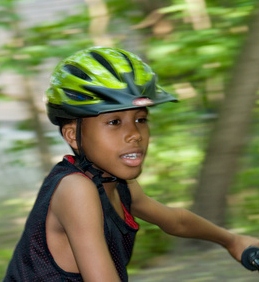 You might be tempted to give up and let his thick skull protect him. And he might be tempted to wear it only until he’s safely out of your sight.
But don't give in. Of the 630 bicyclists killed in 2009, one-eighth were between 5 and 15 years old. Children’s fatality rate is lower than older cyclists’ – but their injury rate is higher. Children under age 16 made up 20 percent of the 51,000 Americans injured in traffic accidents while riding their bikes in 2009.
Your son is more likely than your daughter to need a helmet’s protection – 87 percent of those killed and 80 percent of those injured in bike accidents during 2009 were male.
An easy way to make your child aware of helmets’ benefit is to strap a melon into his helmet. Drop it onto asphalt from the height of his head. Then take it out of the helmet and repeat. Splat!
A common argument – at least in my household – is that the helmet feels funny. My 4-year-old in particular wants to wear his as far back on his head as possible, leaving his forehead exposed and thus unprotected.
Helmets should be no higher than two fingers above your child’s eyebrows. The straps should form a V shape over the ears. There should be no more than two fingers’ width between the strap and chin, and the whole helmet should be tight enough that it’s snug (not loose) when you move your head. Often it’s possible to add padding to get the right fit.
What to buy
The first and most important rule is to measure your child’s head first and then look for that size, not your child’s age, when shopping. If your child is along, test the helmet out. (Make sure it’s facing the right way – not recognizing the front or back is a surprisingly common problem.)
Round-shaped helmets help protect your child’s neck because they slide in a fall. Likewise, it’s better not to use fabric-covered helmets. Always buy a bike helmet for biking and use other helmets for the sports activities they are sold for.
Children under age 1 shouldn’t wear a helmet (or be on a bike, for that matter) due to the risk of neck injury.
The Safe Kids St. Louis Coalition, sponsored by SSM Cardinal Glennon Children's Medical Center, has tips for selecting a helmet, as well as advice on when to wear a helmet, what kind to choose for your activity and when not to wear a helmet (for example, climbing trees, due to a strangulation risk).
The American Academy of Pediatrics goes into detail on the hard shell versus soft shell question, saying that both offer protection and meet safety standards, but hard shell helmets, though heavier, are more durable.
Bike helmets are made of compressed Styrofoam that’s designed to break in a crash, transferring force away from your head. If your child’s helmet has done its job and saved his noggin from impact with a hard surface, replace it even if there’s no visible damage.
Bike helmet fittings
The coming week is one of the best times of the year to find free helmet fittings at hospitals and events throughout the St. Louis area. Not only is the entire month of May designated as Bike Month, we’re going into Bike to Work Week, and the national Bike to Work Day happens on Thursday, May 20.
Three of the many opportunities for helmet fittings this week are:
- Today, May 14, during the Tour de Grove bike race, the Metro East nonprofit Helmets First will do its thing by giving away helmets to race participants and providing free fittings. Founded by pediatrician Dr. Joseph Cangas in 2004,shows up at events across the St. Louis area, giving away free helmets, doing fittings and emphasizing that a substantial number of injuries could be prevented by wearing a bike helmet when riding. To find an event, click here.
- Tuesday, May 17, at the Mercy Children’s Hospital Courtyard Garden, 615 S. New Ballas Road, from 6 to 8 p.m. Fittings are by appointment only and can be made by calling 314.961.2229 or via the Mercy website.
- Saturday, May 21, is the Mary Meachum Freedom and Fun Rides, a 9-mile interpretive ride on trails and city streets, starting from 28 E. Prairie Ave., North St. Louis, at 11 a.m. There’s also a bike rodeo for kids, fully-costumed re-enactment (at 2 p.m.) of tale of urban slave escape in 1855 (with horses). Bike helmet fittings will be part of the free fun. There will also be free helmets for the first 50 youth in need to sign in.
Ongoing helmet fittings include:
- The St. Louis Children's Hospital Safety Stop at Progress West HealthCare Center has helmet fittings by appointment – you can bring your own or buy one of theirs, as explained in this video. They have padding too, if needed. In partnership with St. Louis Children's Hospital, Safety Stop is open at Progress West two days a week! Make an appointment for Monday afternoons or Thursday mornings, call 314.454.KIDS (5437).
- Trained staff members from St. Anthony’s Medical Center’s Emergency Department offer free bicycle helmet fittings for both adults and children (as well as $10 prices on helmets purchased at the fitting), on the first Tuesday of every month, April to October from 4 to 6 p.m. They take place directly behind the main hospital, in the Library of Anthony House (10016 Kennerly). For more information, call 314.525.4002 or 800.554.9550.
By Amy De La Hunt, Health Blogger for SmartParenting
Share This Story

Amy De La Hunt is a journalist and editor who lives in the St. Louis metro area and works across the country as a writer, copy editor, project manager and editorial consultant on everything from fiction books to monthly magazines to blog posts. When she's not chauffeuring her teenage sons to activities, Amy is an enthusiastic amateur cook, landscaper, Latin dancer and traveler. Follow Amy on Instagram @amy_in_words